What the heck is going on with WordPress?
If you are even remotely connected to the WordPress community, and unless you have been living under a rock, or off the grid, you know that since the closing keynote of WordCamp US last week, there’s been a lot of turmoil.
As it is unfortunately often the case in our era where information is cheap, but also hard to verify, it is very difficult to understand precisely what is going on, and how seemingly completely separate things relate to each other.
After reading a lot of nonsense over the past days, I would like to offer an explanation as simple as I can. I hope it will be useful to the many people out there who may not fully understand the situation, and are intelligent enough to realize that. If you think you know everything, and your opinion can’t possibly be challenged, let’s save ourselves some time, you are free to stop reading here.
If you are available for a constructive conversation, welcome!
Why do I think I can help?
Let’s start with this.
I am Paolo Belcastro, I have been using WordPress since 2004. I have been an active member of the WordPress community since 2011 after joining Automattic. Yes, I work for Automattic, and like all my colleagues I am entitled to my opinions, and that’s what I express here.
I have participated, started, and led several community events. I co-launched the Geneva WordPress meetup in 2012, then after moving there, the Vienna WordPress meetup in 2013. I also led the organization of the first WordCamp Vienna, in 2015. I participated in the organization of WordCamp Europe from 2013 to 2017, leading the Volunteer team, the Sponsor team, the local team in Vienna in 2016, and the global team in Paris 2017.
I participated in more than 40 WordCamps over the past 13 years, as a volunteer, an organizer, a sponsor, or a speaker.
Why should you listen to me?
That’s an easy one. You don’t have to. I am offering my perspective, and no one has to accept it as is. All I am trying to do is contribute to a conversation.
If participating in a conversation, expressing your perspective and listening to others, respectfully, is your jam, I hope this will fuel your thoughts.
If not, if you have strong opinions strongly held and are not open to dialogue, here’s a last opportunity to get away. Close this tab, it’s that easy. 🙂
Will I be objective?
Here’s the thing, probably not.
Anyone who claims being objective about something or someone they love is a liar. I love the WordPress project and the WordPress community for everything they have brought to my life. I want to be candid, vulnerable, and honest with you. I’ll admit upfront that I may not be completely objective because WordPress, a project I am deeply attached to, is being attacked.
I’ll try, though, to do my best.
What I can affirm with certainty, is that I am not defending Automattic here, I am defending the WordPress project.
I don’t love WordPress because I work for Automattic, I work for Automattic because I love WordPress. If I thought that Automattic was harming the WordPress project, I’d resign. It’s as simple as that.
So, what’s up with WordPress?
In a nutshell, here’s how I’d resume the situation: a company in the WordPress space has been behaving as a predatory member of the community, focusing exclusively on extracting value from the project, while contributing almost nothing that doesn’t carry a short-term return on investment.
Matt Mullenweg, co-founder of WordPress, lead of the WordPress project, founder and CEO of Automattic, and as such, my boss, has called them out after trying for months in private to convince them to change their behavior.
I will reiterate, once more, that everything you are reading in this post (and on this entire blog, for what matters), are my opinions. I feel the need to repeat this because over the past few days the most frequent rebuttal to anything I, or my fellow Automattic colleagues, may have commented online is: “Your opinion doesn’t matter because you work for Automattic”.
The whole story revolves around three areas, that I want to briefly explore in isolation before explaining how they are connected.
These areas are: 1) contributing to WordPress, an open-source project released under the GPL, 2) trademarks and their abuse, and 3) the infrastructure necessary for the WordPress project to thrive, also known as WordPress.org
1. Contributing to WordPress
Many voices online are repeating the same message: contributing back to an open-source project is not a requirement, and the GPL in no way changes that.
That is absolutely true.
The license doesn’t require you to contribute. There is no law that legally forces you to do so. You can download the software and use it. You can modify it as it suits you, and if you distribute your modified software (which you are allowed to), you must use the same license. But nothing says you have to modify the code.
Here’s the thing, though. This is also true about many other things in life.
There is no law forcing you to give to charities, or to help friends and family in need. No one will sue you for not volunteering any of your time to any activity that helps others. You can use Wikipedia all day long, you don’t have to donate any money to them. Even what you are legally bound to provide for your children is fairly limited. The list goes on and on…
And yet, most of us consider it normal, within the limits imposed by our available time and revenue, to do some or all of those things.
Think about that for a second: we consider it normal to contribute our time or money in situations where we do not expect anything in exchange, just to give back to our communities.
Most members of the WordPress community also consider it normal to contribute back to the project, within the limits that their business size allows, of course. You can learn more about those contributions here.
So here’s my question: what do you think of a company that, with close to half a billion dollars in revenue, and more than a thousand staff, barely contributes the equivalent of one full-time employee to the project on which it has built the entirety of its value?
To preempt questions, I want to clarify one point: working on plugins that one distributes for free, for a price, or with a freemium model, like sponsoring events are not considered contributions. These are investments with an expected return over the short to medium term.
Contributions help the community, improve the core product, without expecting anything in return.
2. Trademark confusion
This is the most complex part. I am not a lawyer, or in any way a trademark expert, so I won’t comment on the legal subtleties of the situation.
I have read, over the past few days, two primary counterpoints to the fact that this company we are talking about benefits from confusing users into thinking they are officially affiliated with WordPress.
The first is that this is also true for WordPress.com
I am certainly not going to argue against the fact that users can be, and frequently are, confused by the difference between WordPress.com and WordPress.org, after all we have support pages just for that.
The important point here is that the WordPress trademarks used to belong to Automattic. Many years ago, probably 15 or so, Matt Mullenweg decided that it would be better to have a non-profit foundation own the trademarks, as that would have guaranteed the health of the WordPress project in case Automattic were to fail and shut down, or be acquired or in any way controlled by an entity hostile to the WordPress project.
Think about that for a moment. Not only wasn’t he in any obligation to do so, but he had to convince his employees, board members, and investors that it was the right thing to do for the greater good. So he made it happen, and the foundation gave Automattic an unlimited license to use and sublicense the trademark
The fundamental difference before and after the transfer is that now, if Automattic were to go bankrupt or fail in any other way, the trademarks wouldn’t be lost with it. Until that happens, though, Automattic can use, and sublicense, the trademarks.
This is why the confusion that WordPress.com may generate and the one that other company generates are not one and the same.
The second is that it’s not so confusing, in the end.
Other voices say that their use of the trademarks is fair and not that confusing.
Let’s play a little game. 😉
Look at the following list of words and try to find the intruder:
wp-activate.php
wp-admin
wp-blog-header.php
wp_commentmeta
wp_comments
wp-comments-post.php
wp-config-sample.php
wp-content
wp-cron.php
wp engine
wp-includes
wp_jetpack_sync_queue
wp_links
wp-links-opml.php
wp-load.php
wp-login.php
wp-mail.php
wp_options
wp_postmeta
wp_posts
wp-settings.php
wp-signup.php
wp_term_relationships
wp_term_taxonomy
wp_termmeta
wp_terms
wp-trackback.php
wp_usermeta
wp_users
What are these words?
Well, all the ones that contain an underscore _ are names of the WordPress core database tables. All the ones that contain a dash - are WordPress core file or folder names. The one with a space is a company name…
By the way, I just mentioned WordPress core a couple of times. Yes, that’s how people in the WordPress community refer to the WordPress software, by opposition to WordPress plugins and themes.
Isn’t it funny that this is that company’s pricing page?
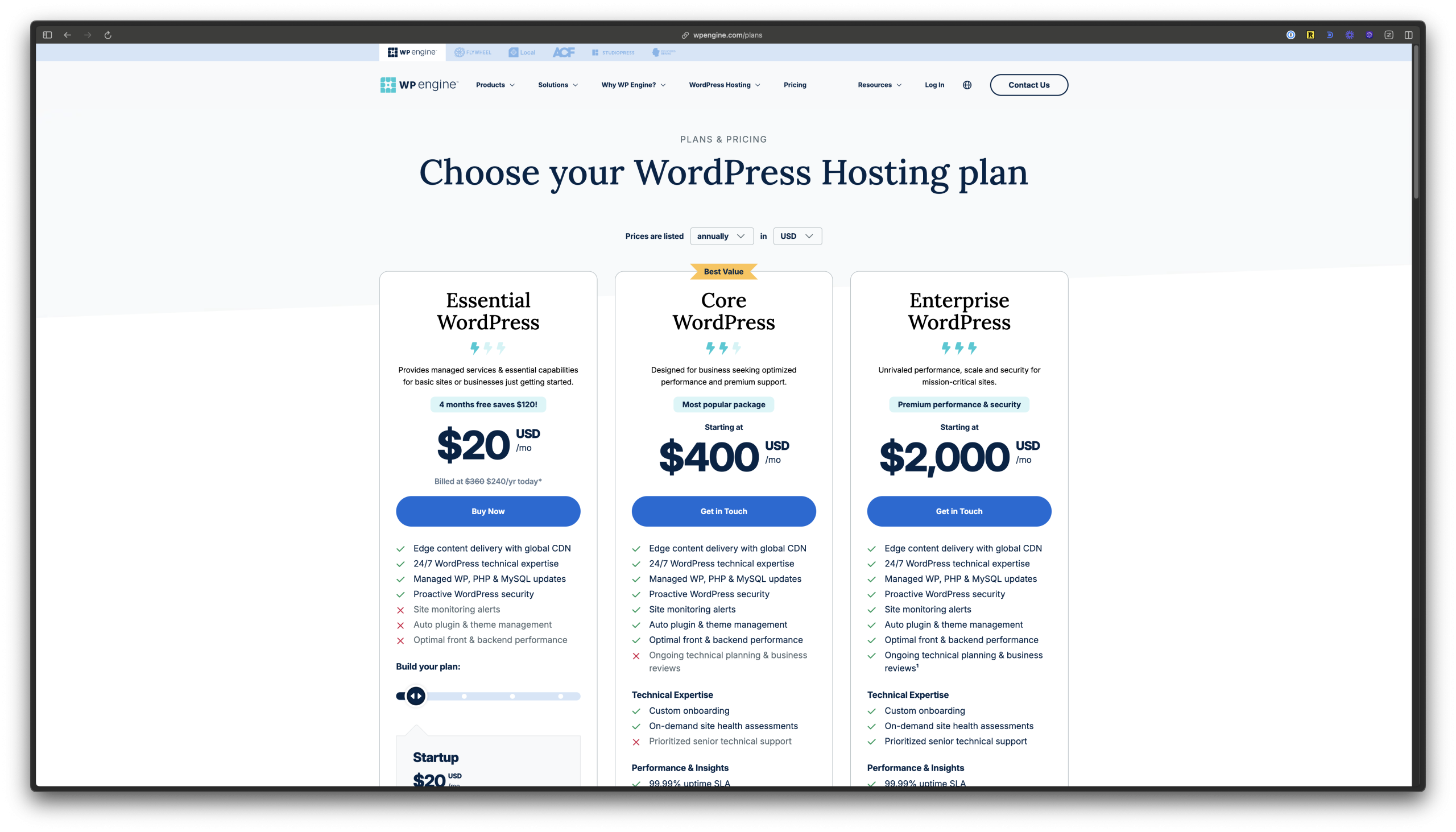
Expert members of the community may not find this confusing, but that doesn’t matter, I understand the difference between WordPress.com and WordPress.org for instance, as these are part of my daily life.
Expert members of the community are not in question here. To more casual WordPress users, which is the vast majority, the confusion is hard to dispute with a straight face.
3. Access to WordPress.org
WordPress is a massive project, after all it powers 43% of the web.
The WordPress community is made of tens, if not hundreds, of thousands of people and companies. WordPress core is made of millions of lines of code, and along it there are tens of thousands of plugins and themes.
WordPress.org is where everything happens. Where groups organize, discuss, and work. Where you can download the WordPress core code (as well as all past releases), the plugins, the themes, the translations.
It’s where every WordPress installation in the world gets code updates.
It’s a massive endeavor, requiring a large team, servers, bandwidth.
It is not, by any means, something that comes for free with every open-source project. It’s not a requirement of the GPL. In fact, it’s not free at all, and is sponsored essentially by Matt Mullenweg personally, and by Automattic.
It is provided for free to the community as the set of tools allowing the project to thrive. It makes possible to work together, but also to meet at WordCamps and other events, equally supported by the same teams.
It costs tens of millions of dollars every year.
So my question to you is, when a company that built all its value on an open-source project decides not to give anything back because such is their right, why should all these resources they are not entitled to be provided for free?
And when access to those resources is cut (it has since been re-established for the sake of that company customers), and that company doesn’t have a plan in place to provide uninterrupted service to their customers, why aren’t they considered at fault?
Eric Mann, longtime community member and contributor, explains that part better than me, so I invite you to read his post.
Here’s a company benefiting from a free resource they are not entitled to. That actually charges their customers for that free service ($3/month to activate auto-updates, something that is free on WordPress), and when they lose access to the free resource, blames others.
How does this all fit together?
It’s quite simple.
For many months, Matt and Automattic have tried to convince that company to increase their contributions to WordPress. Unsuccessfully.
Having failed to convince them, the only possible alternative was trying to force them.
As per the explanation above, one can’t force a contribution to an open-source project. Luckily, one can fight trademark abuse, and can stop providing extra value to which no one is legally entitled and comes as part of giving back to the WordPress project.
So, that’s what happened, plain and simple. They were asked to either start contributing to the project, or pay for a license to use the trademarks, which would have allowed Automattic to contribute to the project for them.
Unfortunately, the lack of preparation of that company in turn affected their customers, as they weren’t ready at all to lose access to freebies.
Listening to those WordPress users, Matt re-established access to WordPress.org for a time in the hope that it will suffice to that company to offer a solution, or to their customers to migrate elsewhere (there are so many hosts of great quality and character out there).
Conflict makes everyone uncomfortable, so many voices ask why not do that behind the scenes, or in the court of law, if needed. The keyword here is transparency. Yes, it’s not comfortable, but it’s much better to handle those things in public as, after all, they impact the entire community.
How does it end?
I am not sure, but my understanding is that the door is open, and that company could simply decide to contribute a few percent of their massive revenue to WordPress to put all that behind us.
If you don’t find that unreasonable, if you can see the forest behind the trees, if you want WordPress to thrive in the long term, maybe it’s time to get over the discomfort, and add your voice to those saying that it’s not ok to only take without ever giving back.
Comments
Gabriel Sieben
It’s a good summary, however, I’ll contribute the following:
Trademarks in the US are not generally enforceable arbitrarily. You use it, defend it, or lose it. The company in question has used the trademark in “confusing” ways for over a decade, and almost every other WP host does similar. The odds that Matt can wield the trademark now as an enforcement mechanism appear to be non-existent. Matt said this is because WordPress.org doesn’t have a beef with them, but trademark law does not work that way.
Even if Matt could use the trademark to force the company to contribute, there was absolutely no need to send threats over text, or to make a public statement about it. This will easily feed into an extortion narrative, and (in my opinion) rightfully so. The correct response, mirrored by almost every business, is to file a lawsuit and refuse further comment.
p3ob7o
I respectfully disagree on the last paragraph, and I just posted this to explain why: https://ttl.blog/leading-is-doing-whats-hard/
About the text messages, I’ll only comment that it’s interesting that they didn’t publish the entire conversation and instead cherry-picked isolated messages. I wonder what that is hiding.
Kay
I’ve seen this argument being touted everywhere by some folks.
I see these kinds of responses do not aim to understand, but rather to criticize. So they bring in technicalities instead of facing the substance of the issue.
The question is, assuming you own a trademark, and someone decides to use it in a confusing way, but knows you’re hesitant on taking action because they can manipulate ignorant bystanders with technicalities and emotions… Would you deal with issues silently, or make sure that you say your side of the story.
WP Engine conveniently shared part of a conversation to shape a narrative. If they truly wanted everyone to know the truth, they’ll publish the entire conversation, including their own responses in full.
I don’t honestly think anyone who wants to be objective and not argumentative cannot see the strategy that WP engine has deployed here.
Keep the technicalities aside. Let the lawyers focus on that.
Let’s truly have a conversation on what’s fair to everyone.
Wade
I’m so glad I don’t use WordPress anymore!
I do have a soft spot for it my heart though. It is what got me into programming. As I continued to grow into a Senior developer I quickly realized WordPress (and PHP as whole actually) is really for beginner and junior developers to really understand what NOT to do. That’s just my opinion.
I’ll be honest, it sounds like Matt is being a little childish about this whole thing. He should go Godfather on them. Make them and offer they can’t refuse and shutter the brand. On the other hand, I’m sure WP Engine can easily afford a license. I also wonder why they’re so opposed to contributing. It would only help their business.
James Bustamante
Really appreciate how this article cuts through the noise and offers a clear, level-headed explanation of what’s going on. As someone who uses WordPress but isn’t deep in the community drama, it’s refreshing to have the tangled threads laid out so simply—helps me understand why even the smartest takes can feel contradictory right now.